
INTRODUCTION
Asking for eight hours of backup sounds precise until nobody has defined what must remain on for those eight hours.
The first step is not asking for eight or twelve hours. It is deciding what truly must stay on, what can stop, and how each load behaves during an interruption.
Decide what cannot turn off before choosing a runtime
A brief interruption, a two-hour outage and an overnight event do not require the same response. Define which event is common, which is tolerable and what losing power would mean.
- Continuous power of each critical load
- Starting peaks and duty cycles
- Loads that operate at the same time
- Usable—not only nominal—battery energy
- Inverter efficiency and operating limits
- Temperature, ageing and design reserve

Runtime begins with load priority
Connectivity, refrigeration, security, lighting and critical processes should be ranked by impact. Some loads can stop or operate in turns; others need immediate continuity.
| Load group | Typical decision | Why it changes the system |
|---|---|---|
| Connectivity | Keep modem, router and access points available | Low power can be operationally critical |
| Security | Maintain selected cameras, recorder and access | Retention and safe entry may matter during an outage |
| Computing | Protect shutdown or continue selected work | Power and runtime vary widely by device |
| Refrigeration or pumps | Review starting current and cycle | Peaks can constrain inverter selection |
| Comfort loads | Decide whether they are truly critical | They can dominate energy demand |

Power, energy and startup peaks impose different limits
A transparent estimate separates nominal capacity from usable energy and clearly states assumptions. It remains an estimate until actual equipment ratings, cycles, installation and environmental conditions are verified.
From critical load to estimated runtime
Four hours for critical loads is not four hours for the whole house
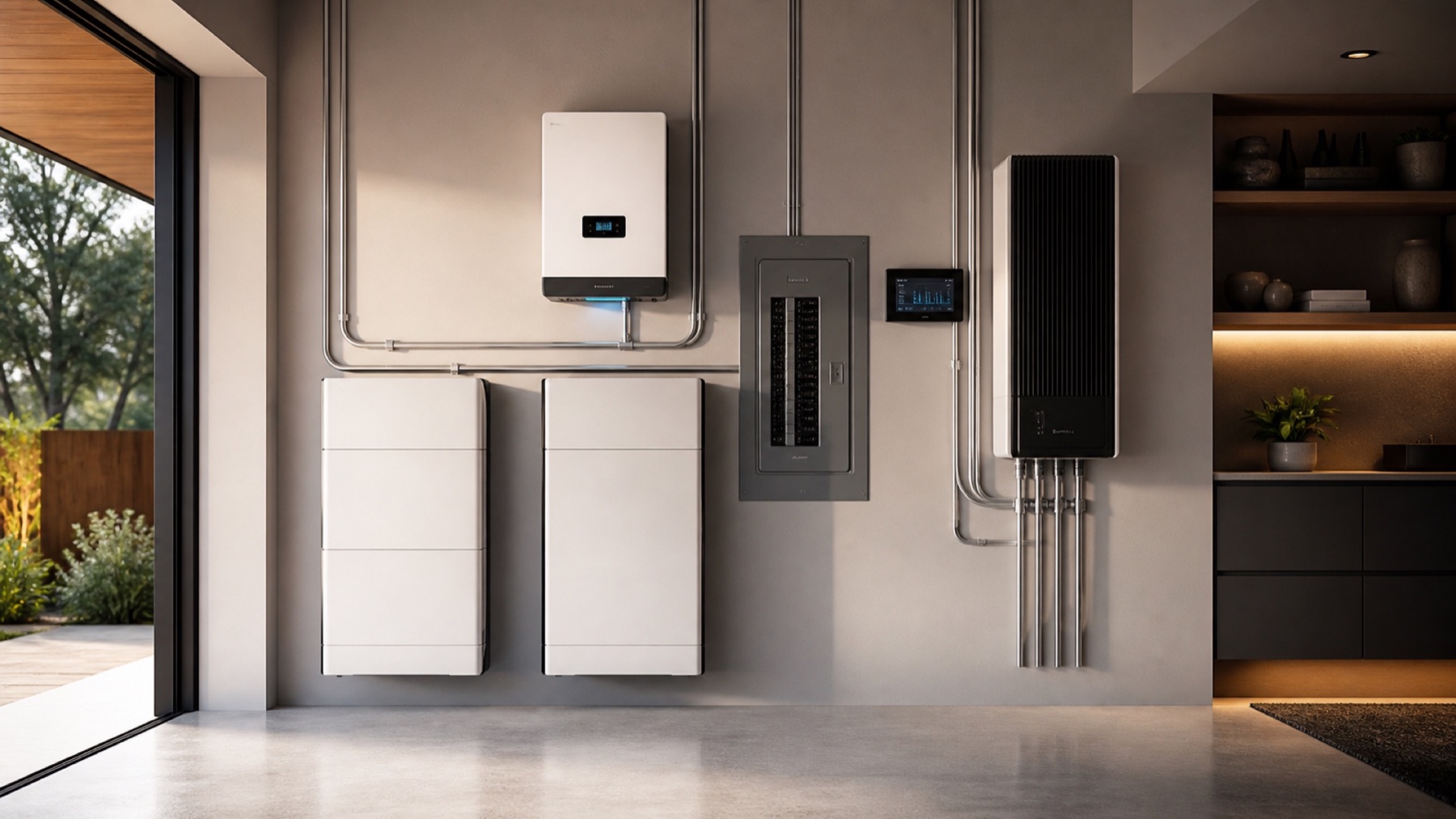
A home prioritizes refrigeration, the Internet gateway, selected lighting and the CCTV recorder during a typical four-hour outage. Air conditioning, electric cooking and other large loads remain outside the protected panel. That choice can reduce both inverter power and battery energy dramatically while preserving the functions the household actually values. Adding every circuit would change the architecture, cost and expected runtime.
Nominal battery capacity is not the energy available to the loads
Size continuity around outage patterns and load priorities
Power determines how many devices and peaks the system can support; usable energy determines how long. Efficiency, reserve, temperature and aging prevent turning nominal capacity directly into guaranteed hours.
Use measured or documented load values, include simultaneous operation and check startup peaks. Then account for usable depth of discharge, conversion efficiency, reserve, temperature and aging. The result should be presented as a scenario with assumptions, not a guaranteed number of hours independent of how the protected circuits are used.
- 01Separate critical and noncritical loads
- 02Collect actual equipment ratings
- 03Check starting peaks and duty cycles
- 04Apply losses and an explicit reserve
- 05Validate protection, ventilation and installation

From context to a decision.
Estimate an autonomy range
Use your actual loads and visible assumptions.
Open calculator↗Review backup equipment
For a defined load and compatible architecture.
Explore Store↗Design operational continuity
For multiple loads, peaks, distribution or integration.
Evaluate my project↗Answers with the full context.
How many hours will a battery last?+
Runtime depends on the actual load and usable stored energy after efficiency, reserve and operating limits. A capacity label alone is not enough.
Should every circuit be backed up?+
Usually the clearer design is to prioritize critical functions. Backing up high-power comfort loads can change cost and architecture substantially.
Why do motors and pumps need special attention?+
Starting current can be much higher than running power, which affects inverter capability even when average energy use appears manageable.
Can a calculator guarantee runtime?+
No. It can expose assumptions and estimate a range. Actual equipment, installation, temperature, battery condition and load behavior must still be verified.
SOURCES AND REFERENCES3
References consulted for this editorial review.
- U.S. Department of Energy — Solar Integration: Solar Energy and Storage Basics.
- U.S. Department of Energy — Solar and Resilience Basics.
- Principio físico de energía = potencia × tiempo; aplicar pérdidas, reserva y especificaciones reales en el cálculo de producto.