


Time
Accelerate preparation, search and classification.


Tell us what you want to improve. We identify where AI can add value, what a person should review and how to turn the output into a useful action.

AI works when it solves a real task inside a clear process.
We do not seek to automate everything or replace your team’s judgment. We design a bounded application with the right information, visible owners, validations and a concrete action at the end.
Accelerate preparation, search and classification.
Turn scattered information into usable context.
Apply defined criteria to repetitive tasks.
Respond faster with better information.
Surface patterns, exceptions and next steps.
Free team capacity for higher-value work.
Explore each capability. None works apart from the context, data and review the use case requires.
CAPABILITY / 01CONTEXT + JUDGMENT
Consult authorized processes and information with clear sources, permissions and escalation.
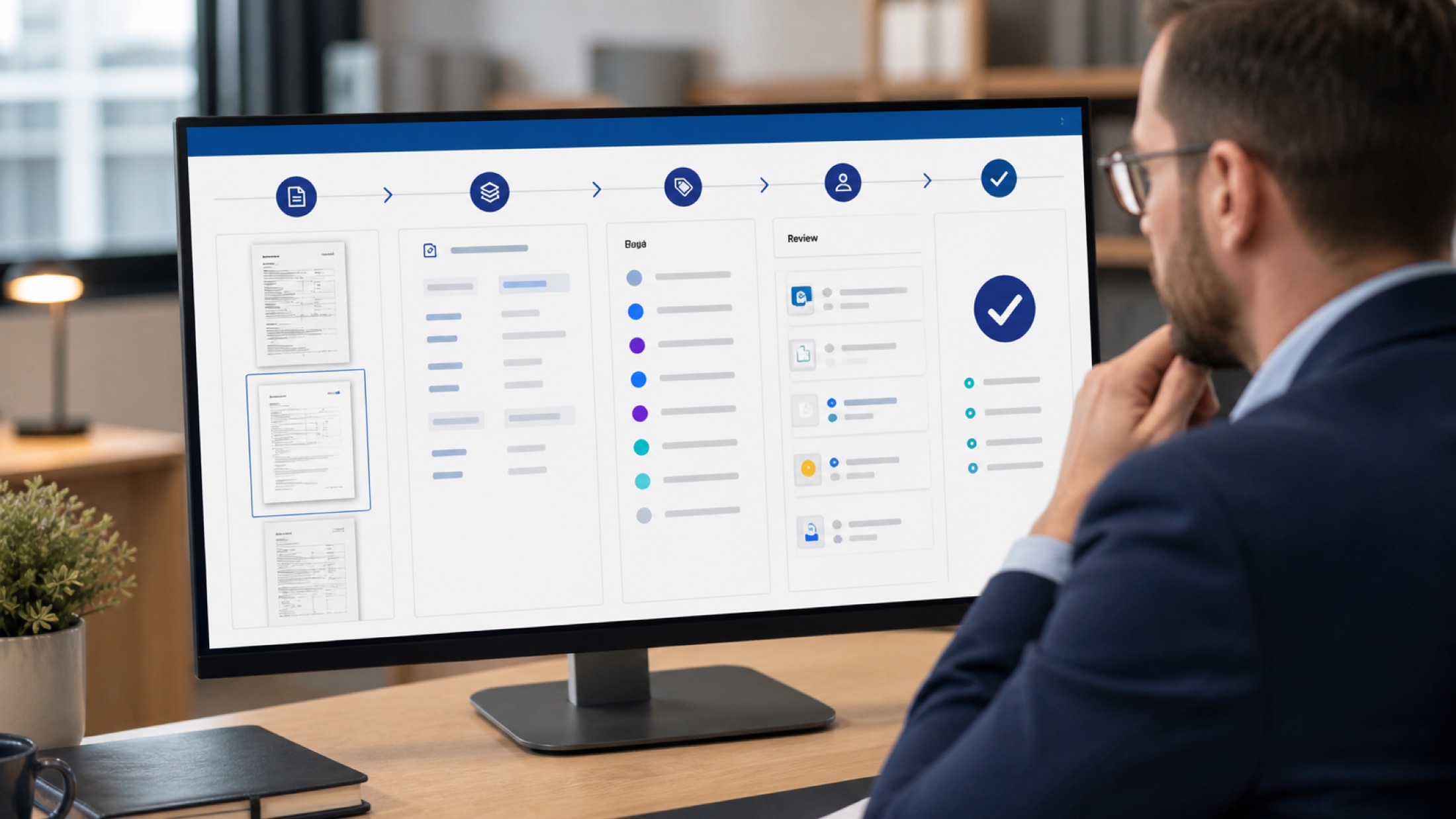 HUMAN REVIEW / SYSTEM CONTROL
The interface changes with the business, but the logic should remain understandable: what enters, what AI does, who reviews and what happens next.
Documents, messages, data or requests.
Information is structured for the use case.
Intent, priority or category is identified.
AI proposes a response or next step.
A person validates when the risk requires it.
The result reaches the right system or owner.
Each area has different problems, information and outcomes. Select one to see concrete possibilities.

 WHY NOW
Starting now does not mean transforming the entire company. It means choosing a useful case, measuring it and building evidence before scaling.
A frequent, costly or slow task.
Data, risk, review and outcome.
A useful pilot with controlled scope.
Improve and expand with evidence.
We can integrate it with workflows, applications, documents and data without turning every step into a probabilistic decision.
Tasks with recognizable inputs, a clear objective and a way to review the result. Ambiguous or high-impact processes need more control and may not be a good first use case.
Not always. A document assistant can begin with a small, well-organized collection; other cases require volume, quality and representative examples.
Potentially, through authorized APIs, databases or integrations. Compatibility, permissions and permitted actions must be verified first.
Yes, with the right retrieval, access and citation architecture. Permissions, source updates and sensitive information handling must be defined.
Yes, for defined questions and processes. It must know when to escalate to a person and never present uncertainty as fact.
Through data minimization, access controls, provider selection, usage logs and rules governing what may enter or leave the system.
No. A rule, form or traditional automation can be more predictable and economical. We use AI only when its capability is needed.
Automation executes defined steps. AI can classify, extract or generate from variable inputs, but requires evaluation and boundaries.
Yes. A bounded pilot measures usefulness, errors, review effort and risk before expansion.
Yes. It can become search, an assistant, classification or a workflow stage while the rest remains deterministic where appropriate.
START WITH THE USE CASEA clear first step can reveal a concrete opportunity without adding unnecessary complexity.
Tell us what you want to improve↗