Sun
Available radiation
→
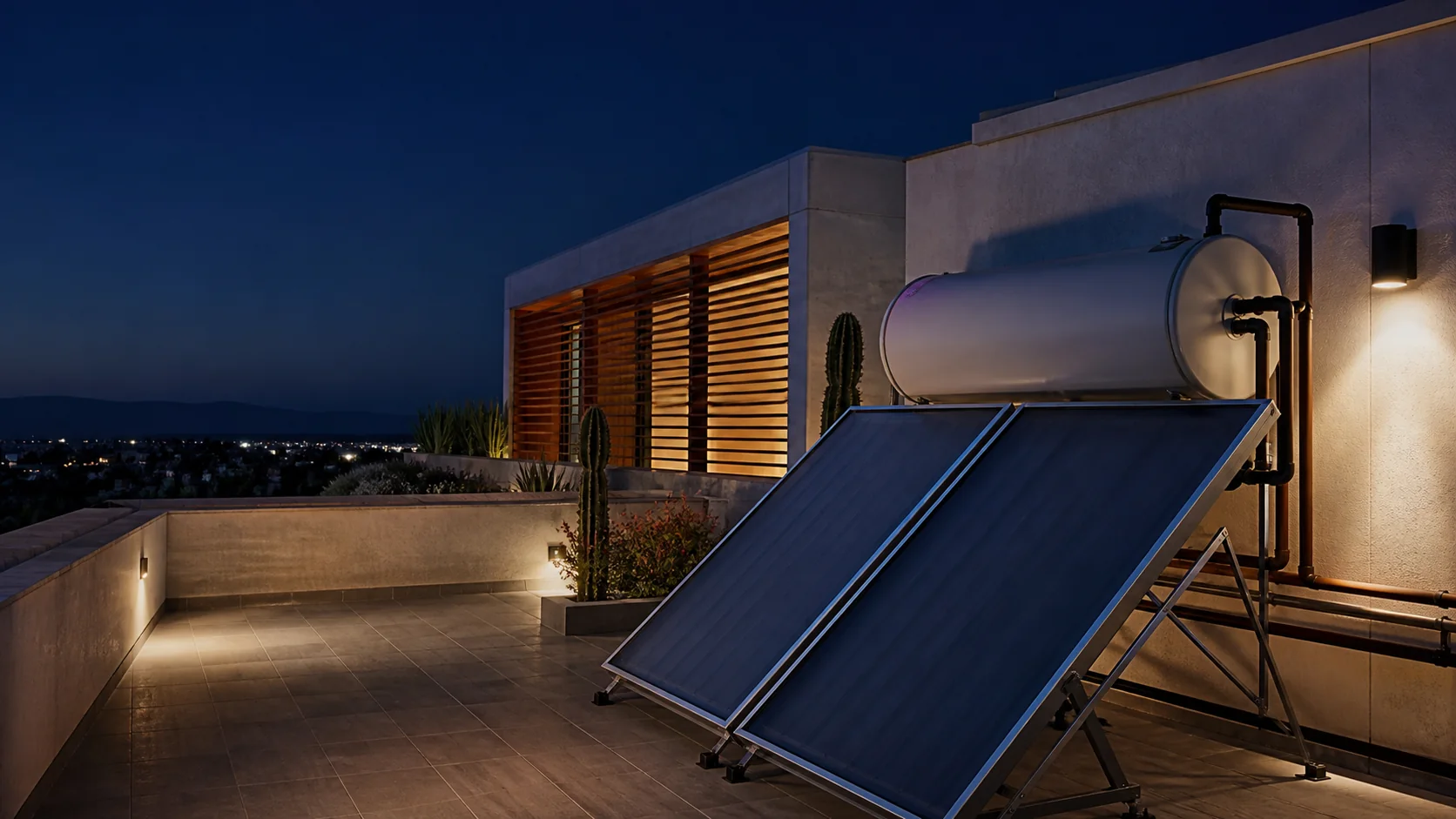
Use solar energy to reduce the gas or electricity demand associated with heating water.

Solar thermal uses radiation to transfer heat directly into water. Design starts with demand, pressure, climate, space, storage and available backup.
Available radiation
→Captures thermal energy
→Moves heat
→Keeps water hot
→Home or operations
Converts radiation into electricity.
Transfers thermal energy into water.
There is no universal savings percentage: each case is evaluated by use, schedules, climate, storage, losses and backup.
Predictable demand from showers, kitchen and services.
Aggregated profiles requiring well-defined hydraulics and storage.
Continuity and recovery around peak-demand schedules.
Hot water for services without separating consumption and backup.
Applications whose hourly profile merits thermal assessment.
Technologies and manufacturers we can work with according to project requirements.


 LOOKING TO HEAT A POOL?
Volume, climate, losses, cover and schedule completely change the strategy.
View pool climate↗A solar water heater transfers solar heat into water. Photovoltaic panels convert radiation into electricity. They are different technologies sized with different variables.
It can capture some diffuse radiation, but thermal output falls. Hot-water availability depends on storage, climate, demand and the backup system.
A gas or electric backup is often retained for low-radiation periods or extraordinary demand. Coordination depends on the existing system.
There is no universal figure. Users, daily demand, inlet and outlet temperatures, climate, collector, storage and losses all matter.
We review daily demand, schedules, radiation, temperature, space, orientation, pressure and backup capacity. Liters alone do not describe the entire system.
It requires an architecture compatible with building pressure. Low-pressure and pressurized systems cannot be substituted without reviewing hydraulics, valves and storage.
Yes, when continuous demand, schedules, space and backup allow an appropriate thermal architecture. Commercial projects need load profiles and redundancy.
It depends on collector type, water quality, scaling, anodes, seals, piping and controls. Current manufacturer instructions and periodic system review must be followed.
NEXTLUM / SOLAR TÉRMICO