

INTRODUCTION
Solar water heating can reduce the work done by gas backup, but no serious percentage exists without knowing demand, climate and habits.
There is no responsible universal savings percentage. The useful question is how much of the hot-water load solar energy can cover at this site, under this usage pattern, and how the gas backup will respond to the remainder.
Separate hot-water gas use from the rest of the bill
Number of people, showers, schedules, inlet temperature and simultaneous use determine required energy. A monthly average does not explain peaks that empty storage.
- Daily hot-water volume and peak periods
- Solar exposure and seasonal variation
- Collector area and thermal losses
- Storage volume and tank insulation
- Backup setpoint and control sequence
- Maintenance, scale and water quality
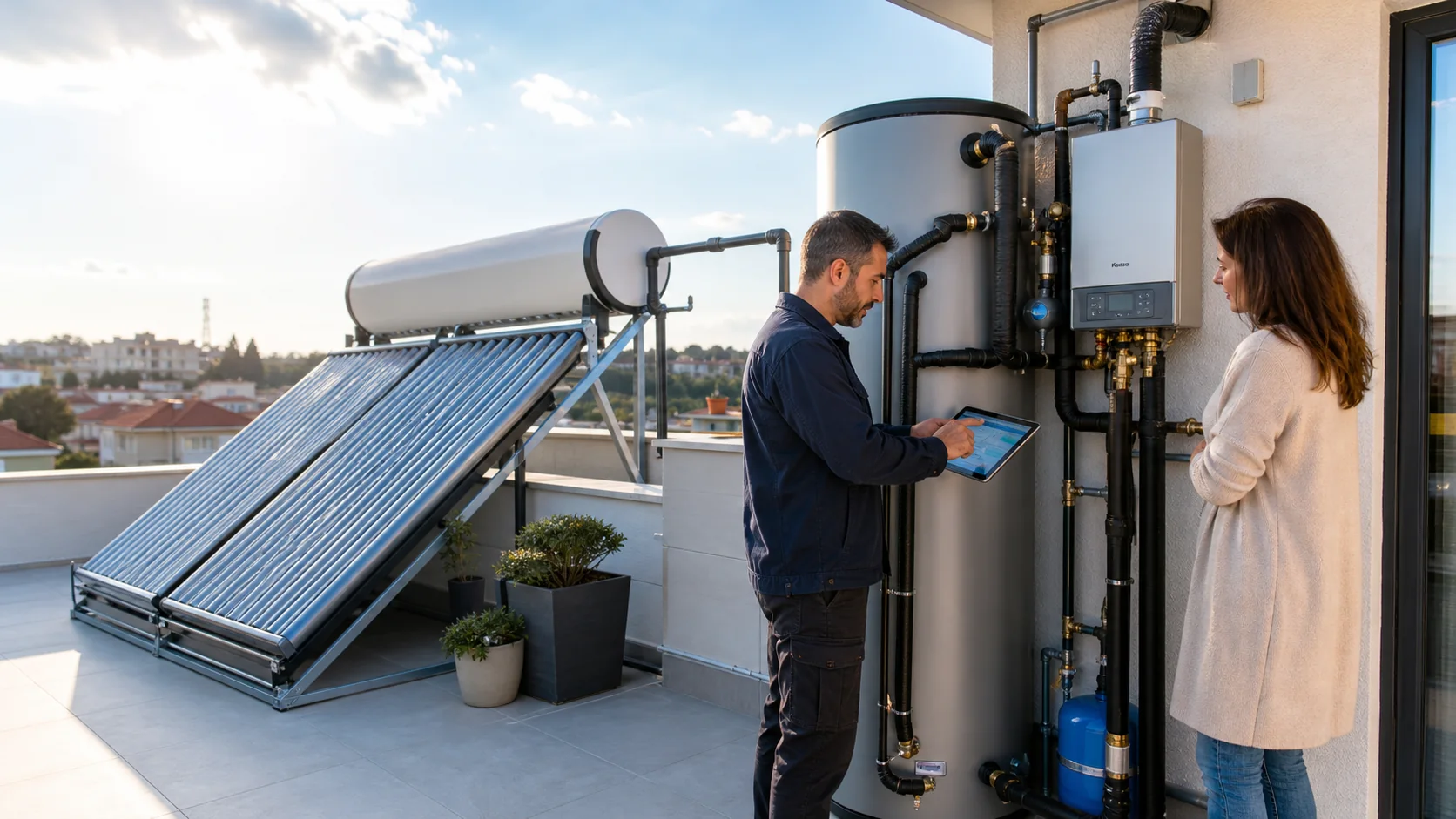
What changes the gas reduction
Orientation, shade, weather and season change captured energy. Sizing seeks an annual balance and keeps backup for lower-availability periods.
| Condition | More favorable contribution | Less favorable contribution |
|---|---|---|
| Demand timing | Use follows stored daytime heat | Large peaks before useful collection |
| Solar access | Clear, well-oriented collection area | Persistent shade or limited area |
| Storage | Sized and insulated for the usage pattern | Insufficient volume or high losses |
| Controls | Solar and backup have a clear sequence | Backup reheats without considering stored solar heat |
| Distribution | Short, insulated runs | Long or poorly insulated piping |

Collection, storage and backup control the result together
The collector does not reduce gas in isolation. Collection, storage, distribution and backup control must work together; otherwise useful solar heat can be lost or the conventional heater can operate when it is not needed.
Where gas use is displaced
The same collector can produce different gas reductions
Imagine two properties with similar equipment. In the first, insulated storage receives useful solar heat and the backup heater waits until temperature actually falls below the agreed threshold. In the second, long uninsulated runs lose heat and the backup reheats the tank on a fixed schedule. Both collect solar energy, but only one converts most of it into avoided gas use. Habits and controls can therefore matter as much as collector area.
A savings percentage without assumptions is not a forecast
Build an estimate that can be checked after installation
Poor configuration can use gas before solar-heated water or cause uncomfortable waits. Controls, valves and temperatures must coordinate comfort and safety.
A responsible baseline separates gas used for water heating from cooking or other loads, records the period being compared and notes changes in occupancy or habits. After installation, review useful temperatures and backup runtime over comparable periods. This does not turn a variable system into a guarantee; it creates a fair way to understand whether the solar contribution is behaving as intended.
- 01Use real fuel bills as context, not as a sizing shortcut
- 02Map demand by time of day
- 03Inspect solar access and piping routes
- 04Define backup setpoints and control
- 05State assumptions before discussing savings

From context to a decision.
Explore compatible equipment
For a requirement that has already been checked technically.
Explore Store↗Estimate contribution in context
For sites where demand, roof, hydraulics and backup require coordination.
Evaluate my project↗Answers with the full context.
How much gas can a solar heater save?+
It depends on the share of the hot-water load covered by useful solar heat. Demand, solar resource, storage, losses and controls must be reviewed before estimating a range.
Will it work on cloudy days?+
Solar thermal can still contribute under some diffuse conditions, but output varies. Backup and storage should be designed for the service level the site requires.
Can a larger collector always save more gas?+
No. Oversizing collection without adequate storage, controls or demand can waste useful energy and add cost without solving the real constraint.
What information is useful for an assessment?+
Hot-water usage, fuel history, roof photographs, available area, pressure, existing heater details and the desired backup behavior provide a practical starting point.
SOURCES AND REFERENCES3
References consulted for this editorial review.
- U.S. Department of Energy — Water Heating.
- U.S. Department of Energy — Consumer Guide to Residential Renewable Energy.
- U.S. Department of Energy / FEMP — Solar Hot Water System Calculator.