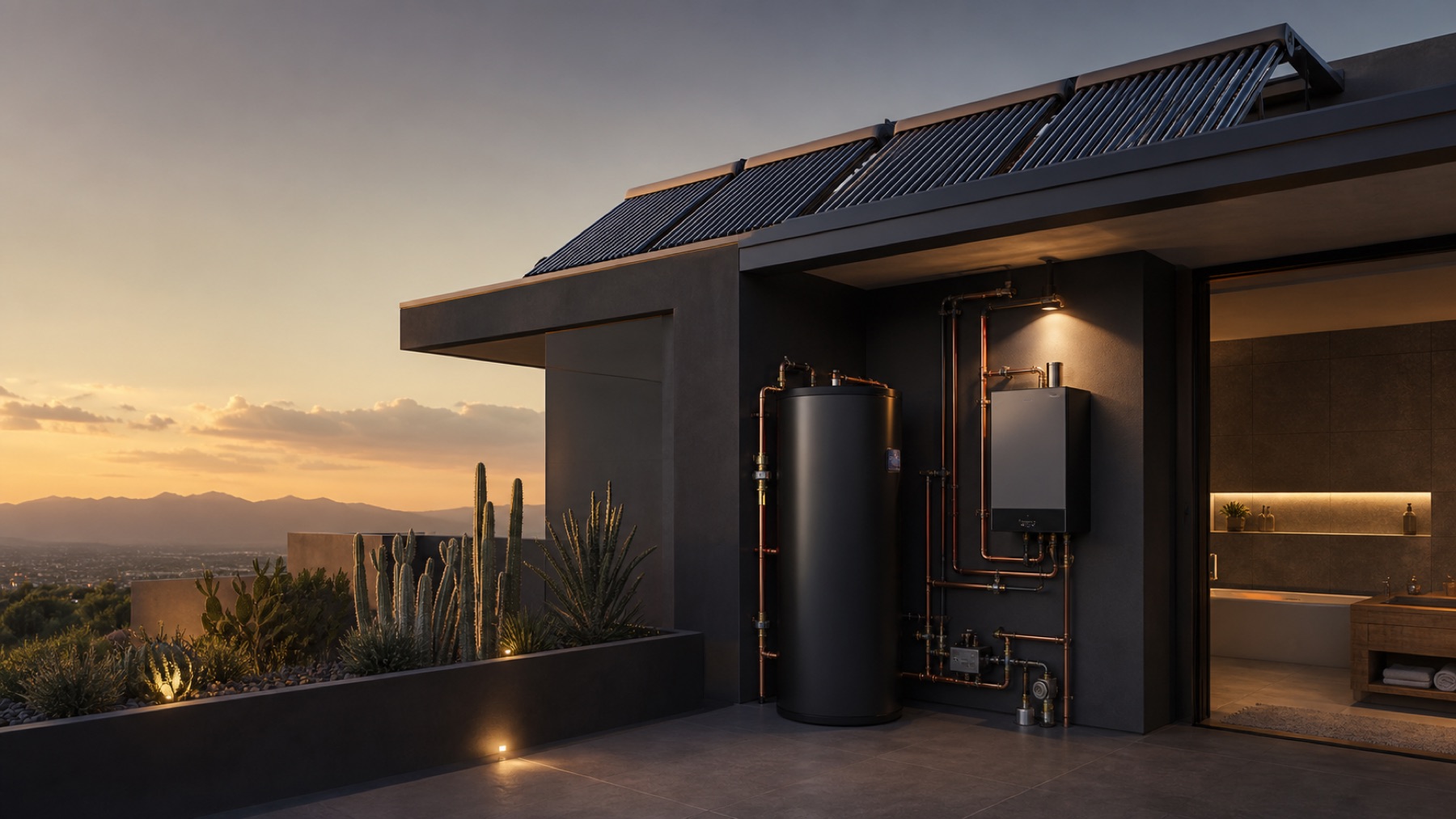

INTRODUCTION
Comparing solar and gas only by equipment price hides what really matters: demand, climate, backup and installation.
Replacing gas with solar is not a one-for-one equipment swap. Gas produces heat when fuel is available; solar thermal captures energy during the day and normally stores it for later use. That difference changes sizing, controls and the role of backup.
Start with the household's hot-water rhythm
Number of users, habits, inlet temperature and simultaneous fixtures determine volume and recovery. Storage must match the real pattern, not a context-free average.
- How many people use hot water and when demand peaks
- Simultaneous showers or fixtures and the desired delivery temperature
- Available roof area, orientation and shading
- Water pressure, flow and quality
- Space for storage and access for maintenance
- What must happen when solar contribution is not enough
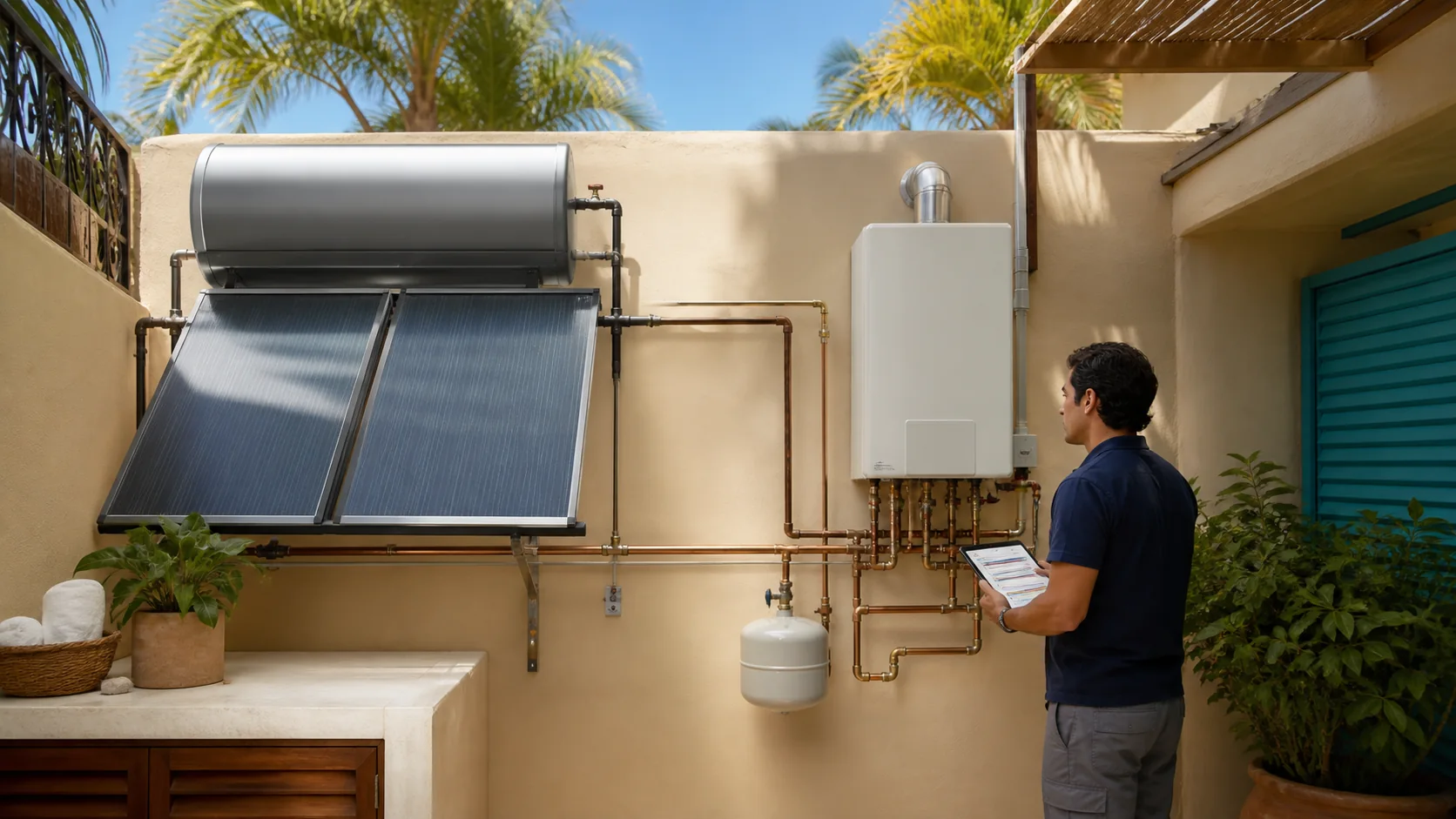
Compare the installed systems, not two boxes
Solar resource, orientation, weather and season vary. A clear architecture defines how backup enters when solar energy does not cover demand, without presenting performance as a universal guarantee.
| Decision factor | Solar thermal | Gas | Solar with backup |
|---|---|---|---|
| Primary input | Available solar energy | Fuel supply | Solar first; backup as required |
| Response to demand | Depends on collection and stored heat | Produces heat within equipment capacity | Storage serves demand while backup covers shortfalls |
| Site requirements | Collector area, storage and hydraulic integration | Fuel, ventilation and safe installation | Coordination between both systems |
| Operating profile | Variable solar contribution | Ongoing fuel use | Designed to reduce backup operation |
| Key question | Can the site capture and store enough heat? | Can the unit cover peak flow safely? | How should storage and backup be controlled? |

Solar, storage and backup must act as one system
A useful comparison includes the entire path from energy source to fixture. Collector area or burner capacity alone says little if storage, mixing, pipe insulation, pressure or water quality are ignored.
From energy source to usable hot water
Two homes can reach two different answers
One household uses most of its hot water before sunrise and has limited roof access; another has strong daytime solar exposure, adequate storage space and demand spread across the day. Even with the same number of residents, the first may depend more heavily on controlled backup while the second can make greater use of stored solar heat. The useful comparison is therefore not solar versus gas in isolation, but how each complete installation serves the actual schedule.
The lowest equipment price can hide the most installation work
Choose between a defined purchase and a coordinated design
Pressure, piping, valves, water quality, roof access and future service are part of the decision. Buying makes sense when these conditions are verified; design is appropriate when several must be coordinated.
Ask every proposal to state the assumed demand, delivery temperature, storage volume, pressure conditions and backup sequence. Those assumptions make competing options comparable and later give the owner something concrete to verify. Without them, a low purchase price and a high projected saving may describe two different systems rather than two offers for the same requirement.
- 01Map hot-water demand by time of day
- 02Confirm pressure, flow and inlet conditions
- 03Review solar access, structure and maintenance access
- 04Define storage and backup behavior
- 05Compare installed and operating costs

From context to a decision.
Review equipment for a defined requirement
Use this route when capacity, pressure, installation and compatibility have already been checked.
Explore Store↗Coordinate solar, storage and backup
Use a project when several variables must be resolved as one installed system.
Design my solution↗Answers with the full context.
Does solar water heating eliminate gas completely?+
Not necessarily. The result depends on demand, solar availability, storage and the desired service level. Many systems retain gas or electric backup for low-solar periods and demand peaks.
Can system size be chosen only from the number of users?+
User count is a starting point, not a complete design input. Timing, simultaneous use, inlet temperature, pressure and storage all change the requirement.
Which option is cheaper?+
The answer changes when installation, adaptations, maintenance and long-term energy use are included. Compare installed systems over the operating context, not only equipment prices.
When does a project assessment make sense?+
When roof conditions, hydraulics, storage, pressure or backup must be coordinated, an assessment reduces the risk of buying equipment that cannot deliver the expected service.
SOURCES AND REFERENCES3
References consulted for this editorial review.
- U.S. Department of Energy — Water Heating.
- U.S. Department of Energy — Consumer Guide to Residential Renewable Energy (sección solar water heating y respaldo).
- U.S. Department of Energy / FEMP — Solar Hot Water System Calculator, como referencia de que el dimensionamiento depende del recurso y la carga, no de un porcentaje universal.